
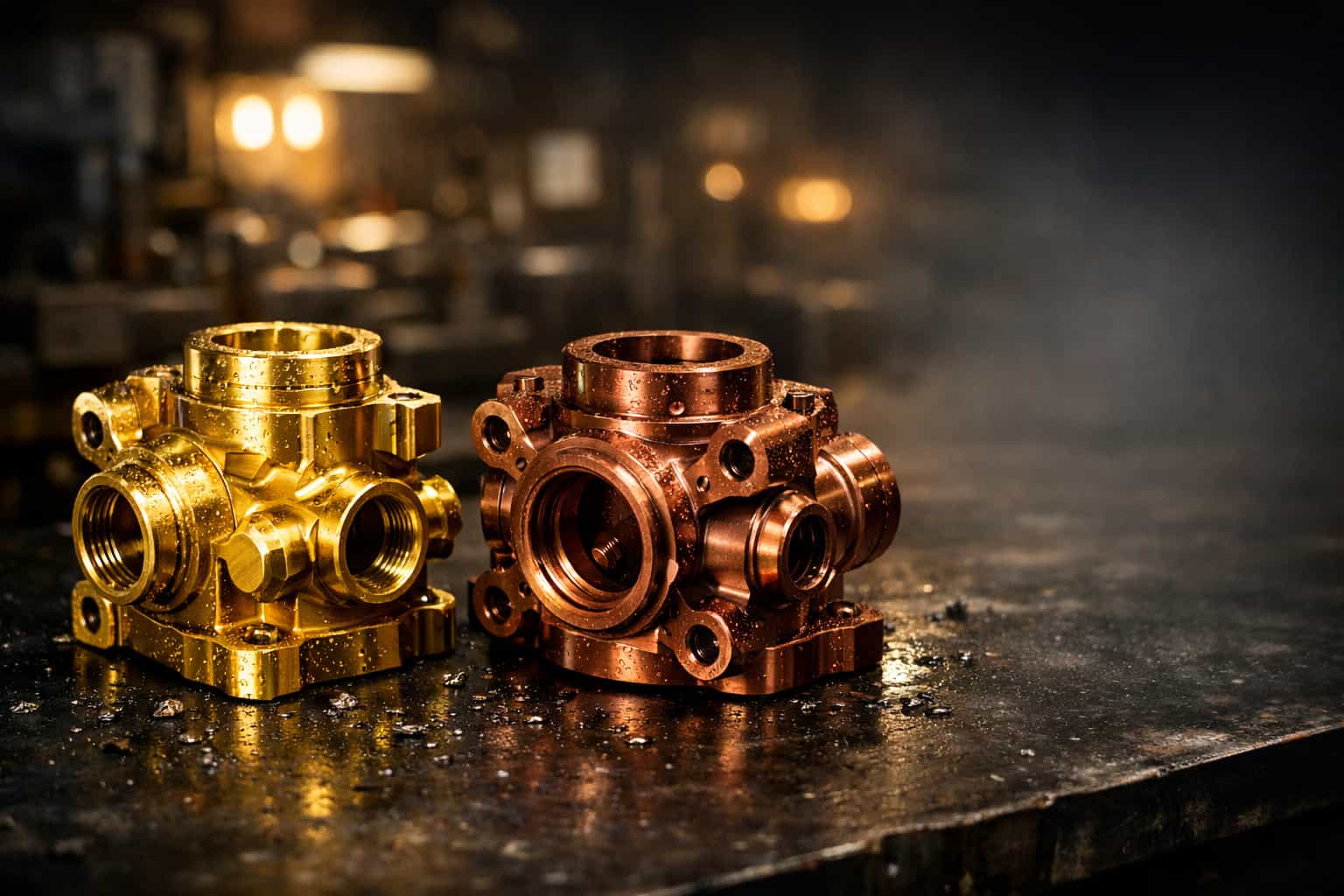
Brass vs. Bronze: A Manufacturing Guide for Material Selection
Introduction: Understanding the Confusion
Brass and bronze, copper alloys that share a similar golden appearance and are frequently confused even by experienced engineers and buyers. Both have served humanity for millennia, both machine beautifully, both resist corrosion, yet they possess distinctly different properties that make each suitable for specific applications.
For manufacturers, specifying the wrong alloy can result in premature failure, increased costs, or dissatisfied customers. This comprehensive guide provides the metallurgical knowledge and practical guidance needed to select confidently between brass and bronze for your components.
Composition: The Fundamental Difference
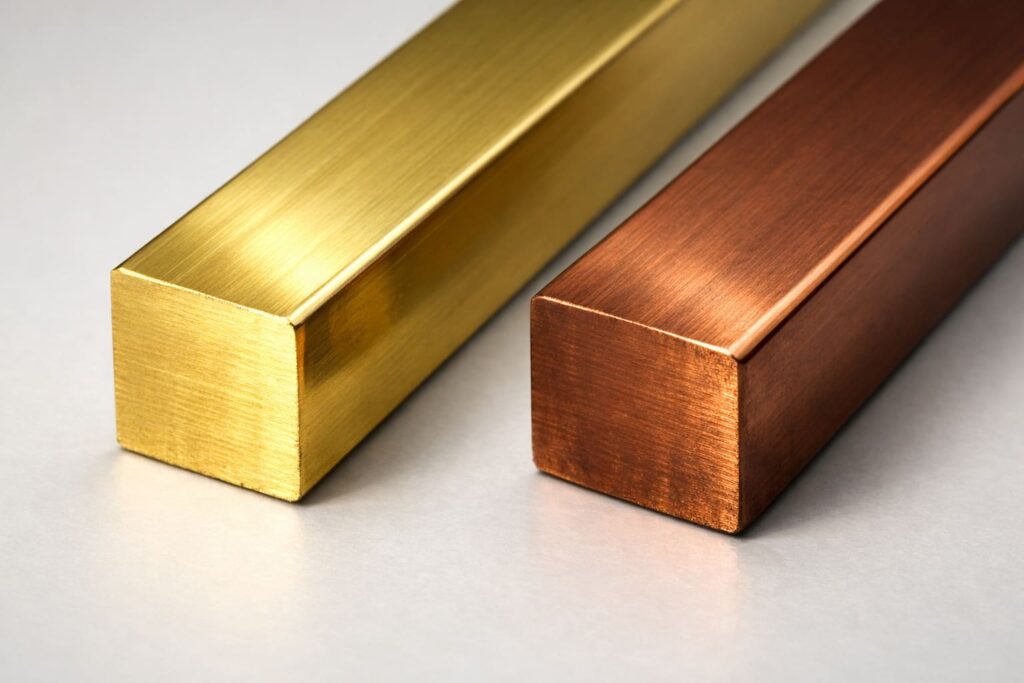
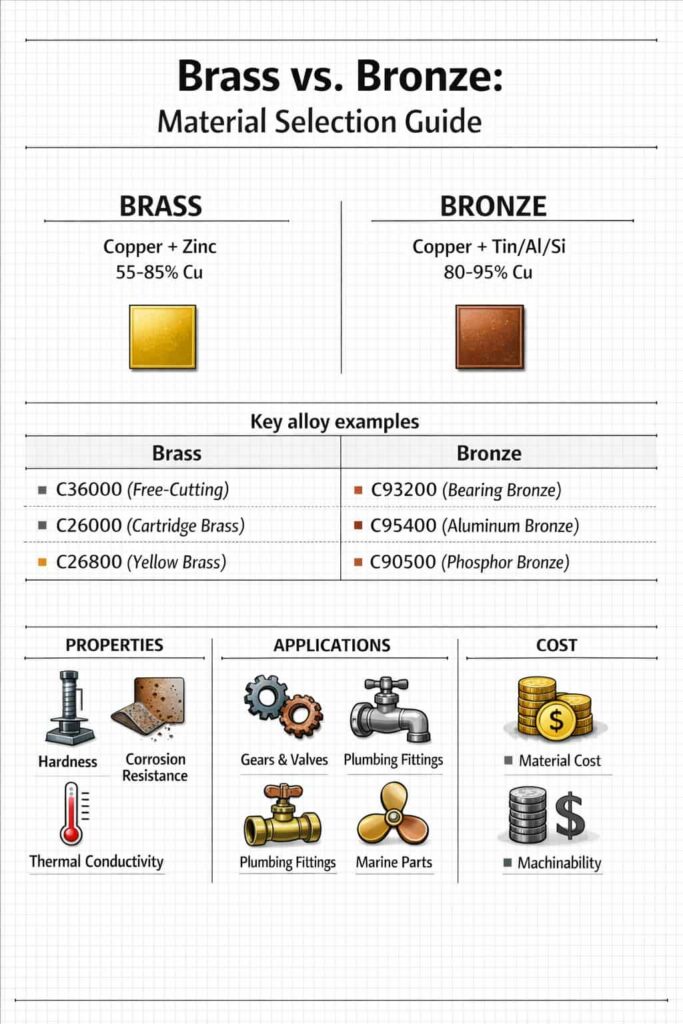
Brass: Copper + Zinc
Primary Alloying Element: Zinc (Zn)
Copper Content: Typically 55-85%
Key Characteristics:
- Excellent machinability (especially with lead additions)
- Good cold workability
- Color ranges from reddish (high copper) to yellow-gold (lower copper)
- Lower material cost than bronze
Common Brass Alloys
| Alloy | UNS | Cu % | Zn % | Other | Primary Application |
| Red Brass | C23000 | 85 | 15 | — | Plumbing, hardware |
| Cartridge Brass | C26000 | 70 | 30 | — | Deep drawing, ammunition |
| Yellow Brass | C27000 | 65 | 35 | — | General hardware |
| Free-Cutting | C36000 | 61.5 | 35.5 | 3% Pb | Machined components |
| Forging Brass | C37700 | 58-61 | 39-42 | 2% Pb | Hot forged parts |
| Naval Brass | C46400 | 60 | 39.25 | 0.75% Sn | Marine applications |
Bronze: Copper + (Tin, Aluminum, Silicon, or Other)
Primary Alloying Elements: Tin (Sn), Aluminum (Al), Silicon (Si), Nickel (Ni), or Phosphorus (P)
Copper Content: Typically 80-95%
Key Characteristics:
- Generally stronger than brass
- Superior wear resistance
- Excellent corrosion resistance (especially seawater)
- No zinc-related dezincification concerns
- Higher material cost
Common Bronze Alloys
| Alloy | UNS | Cu % | Primary Alloying | Key Properties |
| Tin Bronze | C90500 | 88 | 10% Sn | Traditional bronze, excellent castability |
| Aluminum Bronze | C95400 | 83 | 11% Al, 4% Fe | High strength, wear resistance |
| Silicon Bronze | C65500 | 97 | 3% Si | Good strength, weldability |
| Phosphor Bronze | C51000 | 95 | 5% Sn, 0.2% P | Springs, electrical contacts |
| Manganese Bronze | C86300 | 63 | 25% Zn, 6% Al | High strength, bearing properties |
| Nickel Aluminum Bronze | C63000 | 82 | 10% Al, 5% Ni | Premium marine alloy |
Comparative Properties Analysis
Mechanical Properties
| Property | Brass (C36000) | Bronze (C90500) | Bronze (C95400) | Winner |
| Tensile Strength | 58,000 PSI | 45,000 PSI | 85,000 PSI | Bronze (Al) |
| Yield Strength | 45,000 PSI | 22,000 PSI | 35,000 PSI | Brass |
| Hardness (HB) | 85 | 75 | 170 | Bronze (Al) |
| Elongation | 25% | 20% | 12% | Brass |
| Fatigue Strength | 20,000 PSI | 15,000 PSI | 28,000 PSI | Bronze (Al) |
| Machinability | 100% (standard) | 40% | 50% | Brass |
Note: Properties vary significantly by specific alloy and temper.
Corrosion Resistance
Fresh Water
- Both brass and bronze perform excellently
- Brass C23000 and C26000 preferred for plumbing
- Bronze unnecessary cost for most fresh water
Seawater
- Bronze significantly outperforms brass
- Aluminum bronze and nickel-aluminum bronze standard for marine
- Brass subject to dezincification in seawater
- Naval brass (C46400) acceptable for limited marine exposure
Chemical Environments
| Environment | Brass Performance | Bronze Performance | Recommendation |
| Acids (dilute) | Poor | Fair | Neither ideal |
| Alkalis | Good | Good | Either acceptable |
| Chlorides | Moderate (risk dezincification) | Excellent | Bronze |
| Ammonia | Poor (SCC risk) | Poor (SCC risk) | Avoid both |
| Oxidizing acids | Poor | Poor | Neither |
| Non-oxidizing acids | Moderate | Good | Bronze preferred |
Wear Characteristics
Galling Resistance
- Bronze alloys generally superior to brass
- Aluminum bronze excellent against steel
- Tin bronze good for bearing applications
Bearing Properties
| Application | Recommended Alloy | Why |
| Light loads, oil lubricated | C93200 (SAE 660) | Standard bearing bronze |
| Heavy loads, slow speed | C95400 | High strength, embeddability |
| Marine propellers | C95800 | Cavitation resistance |
| Pivot bushings | C86300 | Manganese bronze, durable |
| Food equipment | C54400 | Lead-free phosphor bronze |
Manufacturing Process Considerations
Machinability Comparison
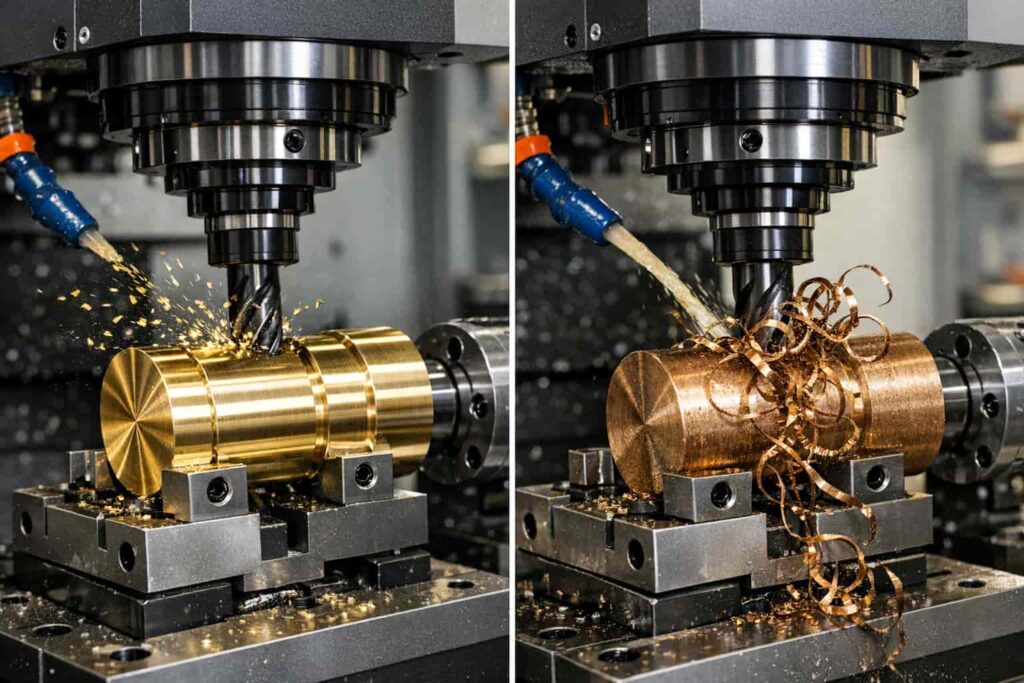
Brass Machinability Advantages
- C36000 is the machinability standard (rated 100%)
- Free-machining grades produce small, broken chips
- Minimal tool wear
- Excellent surface finish achievable
- High cutting speeds possible
Bronze Machining Considerations
- Generally 30-50% machinability of brass
- Long, stringy chips (especially tin bronzes)
- Higher cutting forces required
- More frequent tool changes
- Lower surface speeds recommended
Machining Parameter Recommendations
| Parameter | Free-Cutting Brass (C36000) | Aluminum Bronze (C95400) |
| Cutting Speed (SFM) | 300-800 | 150-300 |
| Feed Rate (IPR) | 0.005-0.015 | 0.003-0.010 |
| Depth of Cut | Full depth possible | Conservative recommended |
| Tool Material | HSS or Carbide | Carbide preferred |
| Coolant | Optional | Required |
Casting Characteristics
Brass Casting
- Excellent fluidity
- Lower pouring temperatures (1,650-1,850°F)
- Good for intricate shapes
- Sand, investment, and die casting all suitable
- Lower energy costs
Bronze Casting
- Tin bronzes: Excellent castability, used for statuary and bearings
- Aluminum bronzes: Higher pouring temps (2,000-2,200°F)
- More prone to oxidation during pouring
- Excellent for heavy-section castings
- Sand and investment casting preferred
Casting Process Selection
| Volume | Brass Method | Bronze Method |
| Prototype (1-10) | Sand or investment | Sand or investment |
| Low (10-100) | Sand | Sand |
| Medium (100-10,000) | Permanent mold | Investment |
| High (10,000+) | Die casting | Centrifugal (for bearings) |
Forging and Forming
Brass
- Excellent hot and cold forgeability
- C37700 specifically designed for hot forging
- Cold heading common for fasteners and fittings
- Deep drawing capability (cartridge cases, cups)
Bronze
- Hot forging preferred
- Cold work limited (work hardens rapidly)
- Silicon bronze (C65500) has best formability
- Aluminum bronze requires high forging temperatures
Joining Methods
Soldering and Brazing
- Both solder and braze well with appropriate fluxes
- Bronze requires higher brazing temperatures
- Careful joint design for dissimilar metal joining
Welding
| Alloy | Weldability | Method |
| C36000 (Brass) | Fair | Gas, TIG (zinc fuming issues) |
| C23000 (Brass) | Good | Gas, TIG |
| C51000 (Phos. Bronze) | Excellent | TIG, resistance |
| C65500 (Silicon Bronze) | Excellent | TIG, MIG (gas metal arc) |
| C95400 (Alum. Bronze) | Good | TIG with DCEP |
Cost Analysis
Material Costs (Approximate, 2026)
| Alloy | Form | Cost per lb (USD) | Relative Cost |
| C36000 (Brass) | Rod/bar | $3.50-4.50 | 1.0× (baseline) |
| C26000 (Brass) | Sheet | $3.00-4.00 | 0.9× |
| C83600 (Red Brass) | Ingot | $3.75-4.75 | 1.1× |
| C90500 (Tin Bronze) | Ingot | $4.50-6.00 | 1.4× |
| C93200 (Bearing Bronze) | Bar | $5.00-7.00 | 1.5× |
| C95400 (Alum. Bronze) | Bar | $6.00-8.50 | 1.8× |
| C63000 (Ni-Al Bronze) | Bar | $8.00-12.00 | 2.5× |
| C65500 (Silicon Bronze) | Wire | $4.50-6.50 | 1.4× |
Total Cost of Ownership
Factor brass advantages:
- Lower material cost
- Higher machining speeds (lower labor cost)
- Less tool wear
- Faster production times
Factor bronze advantages:
- Longer service life in aggressive environments
- Reduced maintenance/replacement costs
- No dezincification failure risk
- Better wear properties (longer bearing life)
Break-Even Analysis Example: Marine Valve Handle
| Factor | Brass (C46400) | Bronze (C95400) |
| Material cost | $4.00 | $7.00 |
| Machining time | 15 min | 25 min |
| Tool cost | $2.00 | $5.00 |
| Unit cost | $20 | $35 |
| Service life (seawater) | 5 years | 20+ years |
| 20-year cost | $80 (4 replacements) | $35 |
Bronze is clearly the economic choice for long-term marine applications despite higher initial cost.
Application-Specific Selection Guide
Plumbing and Fluid Handling
| Component | Recommended | Rationale |
| Potable water valves | C23000, C26000 brass | Cost, NSF/ANSI 61 compliance |
| Seawater valves | C95800, C63000 bronze | Corrosion resistance |
| Steam fittings | C83600 brass, C92200 bronze | Heat resistance |
| Sanitary fittings | C36000 (lead-free), C54400 bronze | Machinability, no lead |
| Pressure vessels | C83600 brass, C95400 bronze | Strength requirements |
Electrical Applications
| Component | Recommended | Rationale |
| Terminals | C36000 brass | Conductivity, machinability |
| Springs/contacts | C51000 phosphor bronze | Elasticity, fatigue resistance |
| Busbars | C11000 copper (pure) | Maximum conductivity |
| Connectors | C26000 brass | Formability, cost |
| Switches | C54400 phosphor bronze | Wear resistance |
Marine and Offshore
| Component | Recommended | Rationale |
| Propellers | C95800 nickel-aluminum bronze | Cavitation resistance |
| Seawater pumps | C95500 aluminum bronze | Corrosion, erosion resistance |
| Valve bodies | C95800, C63000 | Pressure, corrosion resistance |
| Fasteners | C65500 silicon bronze | Strength, galvanic compatibility |
| Heat exchangers | C68700 aluminum brass | Heat transfer, cost balance |
Decorative and Architectural
| Application | Recommended | Rationale |
| Door hardware | C26000, C27000 brass | Color, formability |
| Statuary | C90500 tin bronze | Traditional appearance, castability |
| Marine hardware | C65500 silicon bronze | Weather resistance |
| Furniture | C23000 brass | Color, workability |
| Fasteners (exterior) | C65500 silicon bronze | No rust, no staining |
Industrial Machinery
| Component | Recommended | Rationale |
| Bushings/bearings | C93200, C95400 bronze | Wear properties |
| Gears | C95400 aluminum bronze | Strength, wear |
| Worm wheels | C93200 tin bronze | Compatibility with steel worms |
| Valve seats | C83600 brass, C95400 bronze | Machinability, durability |
| Pump impellers | C95500 aluminum bronze | Cavitation resistance |
Common Selection Mistakes
Mistake 1: Specifying Bronze When Brass Is Sufficient
Problem: Unnecessary cost increase of 40-150%
Solution: Evaluate actual service conditions. If:
- Not exposed to seawater
- No heavy bearing loads
- No severe wear conditions
- Brass likely sufficient
Mistake 2: Using High-Zinc Brass in Marine Environments
Problem: Rapid dezincification failure
Solution:
- Specify aluminum bronze or nickel-aluminum bronze for seawater
- If brass required, use C46400 naval brass maximum
- Consider cathodic protection systems
Mistake 3: Ignoring Machinability in High-Volume Production
Problem: Increased cycle times, tool costs, rejects
Solution:
- For high-volume machined parts, specify free-machining brass (C36000) if properties permit
- Consider near-net-shape casting for bronze components to minimize machining
- Calculate total cost including machining
Mistake 4: Mixing Brass and Bronze in Assemblies
Problem: Galvanic corrosion potential
Solution:
- Generally compatible (both copper alloys)
- Minor galvanic potential difference
- In seawater, bronze should be more noble component
- Use dielectric isolation if concerned
Mistake 5: Specifying by Color Only
Problem: Brass and bronze can appear similar; composition determines performance
Solution:
- Always specify by UNS alloy number
- Require material certifications
- Verify incoming material with XRF or similar
Southeast Asia Manufacturing Context
Regional Availability
Thailand
- Extensive brass availability (C23000-C37700)
- Bronze selection limited, especially specialty alloys
- Aluminum bronze and phosphor bronze available from distributors
- Nickel-aluminum bronze typically imported
China
- Full range of brass and bronze alloys available
- C95400, C95800 produced domestically
- Cost advantages for both materials
- Quality varies when sourcing from certified mills
Japan/Korea
- Highest quality alloys available
- Premium pricing
- Excellent for aerospace and medical applications
Export Considerations
US Market
- NSF/ANSI 61 for potable water contact
- NSF/ANSI 372 lead content requirements
- RoHS compliance for electronics
European Market
- REACH compliance
- EN material standards may differ from ASTM
- CE marking requirements for certain applications.
Conclusion
Choosing between brass and bronze is ultimately about matching material performance to the real demands of the application. Brass may be the better fit where machinability, cost efficiency, and high-volume production matter most, while bronze becomes the stronger choice for harsher environments that demand superior wear and corrosion resistance. At Align Mfg, we help customers make that decision with confidence by combining technical material knowledge with practical manufacturing experience, ensuring every component is selected not just for price or appearance, but for long-term performance and production efficiency. As a company with expertise in thailand precision machining, we understand how the right alloy choice directly impacts machining quality, service life, and total project cost.
For engineers, buyers, and product developers, the difference between brass and bronze should never be reduced to colour alone. Successful material selection depends on application conditions, expected lifespan, manufacturability, and downstream performance in the field. Align Mfg supports this process with a manufacturing-first approach, helping clients turn material specifications into reliable, production-ready parts that meet demanding industrial standards. Whether the requirement is for corrosion resistance, strength, or precision-machined consistency, our team works to deliver solutions that are both technically sound and commercially practical.
FAQ
Q1: Can you distinguish brass from bronze visually?
A: Sometimes, but not reliably:
- Color: High-copper brass (C23000) is reddish like bronze; low-copper brass (C28000) is distinctly yellow. Tin bronze tends toward reddish-brown; aluminum bronze more golden.
- Sound: Bronze rings with clearer tone; brass slightly duller.
- Certain identification: Requires chemical analysis (XRF) or spark test by experienced metallurgist.
Q2: Why is bronze more expensive than brass?
A: Several factors:
- Raw materials: Tin more expensive than zinc; aluminum bronze requires high-purity aluminum
- Processing: Higher melting temperatures increase energy costs
- Volume: Brass produced in much larger quantities (economies of scale)
- Applications: Bronze often specified for critical/long-life applications, commanding premium
Q3: Can bronze be machined as easily as brass?
A: Generally no. Free-cutting brass (C36000) is the machinability standard. Most bronzes machine at 30-50% that speed. Exceptions:
- C54400 (lead-free phosphor bronze) machines reasonably well
- C65500 (silicon bronze) is machinable but work-hardens
- Tin bronzes produce stringy chips requiring management
Q4: Is bronze always stronger than brass?
A: Generally yes, but with exceptions:
- Cold-worked brass (H04 temper) can exceed cast bronze strength
- Aluminum bronzes (C95400, C63000) are significantly stronger than any brass
- Bearing bronzes (C93200) prioritize lubricity over strength
- Always compare specific alloys and tempers
Q5: Will brass and bronze corrode if used together?
A: Minimal galvanic concern:
- Both are copper alloys with similar electrode potentials
- In most environments, no significant galvanic corrosion
- In seawater, bronze is slightly more noble—brass would corrode preferentially if any
- Best practice: Use same alloy or bronze for more critical component
Q6: Can I substitute brass for bronze in a bearing application?
A: Generally not advisable:
- Bronze bearings designed for embeddability (dirt embeds without scoring shaft)
- Brass lacks tin content that provides lubricity
- Bronze bearing alloys formulated for specific wear properties
- Emergency short-term: possible; long-term: expect premature failure
Q7: What’s the best alloy for saltwater exposure?
A: For continuous seawater immersion:
- C95800 (Nickel-Aluminum Bronze) – Best overall
- C95500 (Aluminum Bronze) – Good, less expensive
- C63000 (Nickel-Aluminum Bronze) – High strength
For occasional salt spray:
- C46400 (Naval Brass) acceptable
- C65500 (Silicon Bronze) good corrosion resistance
Q8: How do I specify material to avoid receiving the wrong alloy?
A: Best practices:
- Specify UNS number (e.g., “C36000 per ASTM B16”) not just “brass”
- Require material certification with chemical composition
- Verify incoming material with XRF gun or lab analysis for critical applications
- Use qualified suppliers with material traceability systems
- Include acceptance testing in purchase agreements